


Why We Love Forest School: A Glimpse into Our Learning Philosophy
Nestled in the woods of Washington State’s Key Peninsula, you can find a magical place where young learners laugh, play, and grow. At Forest Friends, we offer our students space and time to explore freely and connect with themselves, each other, and the natural world around them. When we founded our wonderful Forest School in the Summer of 2024, we envisioned more than just a typical preschool; we wanted to create a space that would root children in wonder and curiosity, and in doing so, offer something our community could cherish for generations to come.
At Forest Friends, our students won’t be found sitting at desks between four walls. Instead, nature serves as their classroom. This philosophy is grounded in the Forest School model, which originated in Scandinavia in the 1950s. There, teachers understood the profound impact of encouraging children to spend most of their time outside, realizing that learning can happen through unstructured exploration and play in the natural environment.
The Forest School curriculum is child-led and inquiry-based, which means that while our amazing teachers provide a thoughtful predictable rhythm to the day, we encourage our students to follow their curiosities when it comes to their projects. As educators, we empower them to make their own choices, ask questions, solve problems, and engage deeply with the world around them.
Here are just a few reasons why we’re so passionate about the Forest School philosophy:
Cognitive Growth
Outdoor learning environments offer countless opportunities for organic, hands-on discovery. Research shows that Forest School education supports brain development by encouraging children to think critically, solve problems, and make real-world decisions. When children direct their own learning, they retain information more deeply and develop an internal motivation to explore and understand. These are foundational skills that carry over into academic settings and lifelong learning.
Confidence, Risk-Taking, and Emotional Intelligence
In the forest, children learn to navigate the rain, the mud, the snow, and dryer sunny days. They learn to listen to their bodies as they balance on logs and climb trees. With guidance from our educators, students develop the tools to assess what’s safe, when to ask for help, and how to listen to their bodies and instincts. This builds confidence and nurtures emotional resilience.
Connectedness to Nature
In line with ecopsychology, children who learn outside every day develop a deep, respectful relationship with the Earth. By paying attention to the rhythms of the seasons, caring for the plants and living creatures, and noticing the interconnectedness of the ecosystem, this relationship lays the groundwork for a lifelong reverence for the natural world.
Health and Wellbeing
Time in nature has been shown to reduce stress and anxiety in children, which we’ve noticed first-hand as teachers. Fresh air, sunlight, and open-ended play support physical wellness and emotional regulation, which cultivates mindfulness, patience, and presence.
Creativity
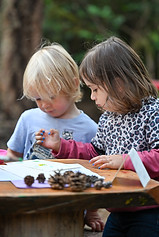
At Forest Friends, our students are constantly engaging their senses—from the sound of crunching leaves to the feel of soft moss on their fingers. These textures, sounds, and sensations offer endless creative inspiration to our students and teachers, and we’ve found immense delight in watching them in their creative flow. In addition to our weekly art classes in our flexible Atelier space, children have daily opportunities to create with gathered materials. We honor their creativity through regular documentation, capturing moments of wonder and the many ways they make meaning of their world.
References
Blackham, L., Cocks, A., & Bunce, L. T. (2021). ‘Our Forest School isn’t just the trees.’ Forest Schools: micro-communities for social and emotional development. Journal of Adventure Education and Outdoor Learning, 23(2), 158–169. https://doi.org/10.1080/14729679.2021.1984964
Dave Rylance. (2022). Forest School and Encouraging Positive Behaviour : Outdoor Education Skills for Pupils with Additional or Complex Needs. Jessica Kingsley Publishers.
Forest School Association. (n.d.). What is Forest School? https://forestschoolassociation.org/what-is-forest-school/
Comments